

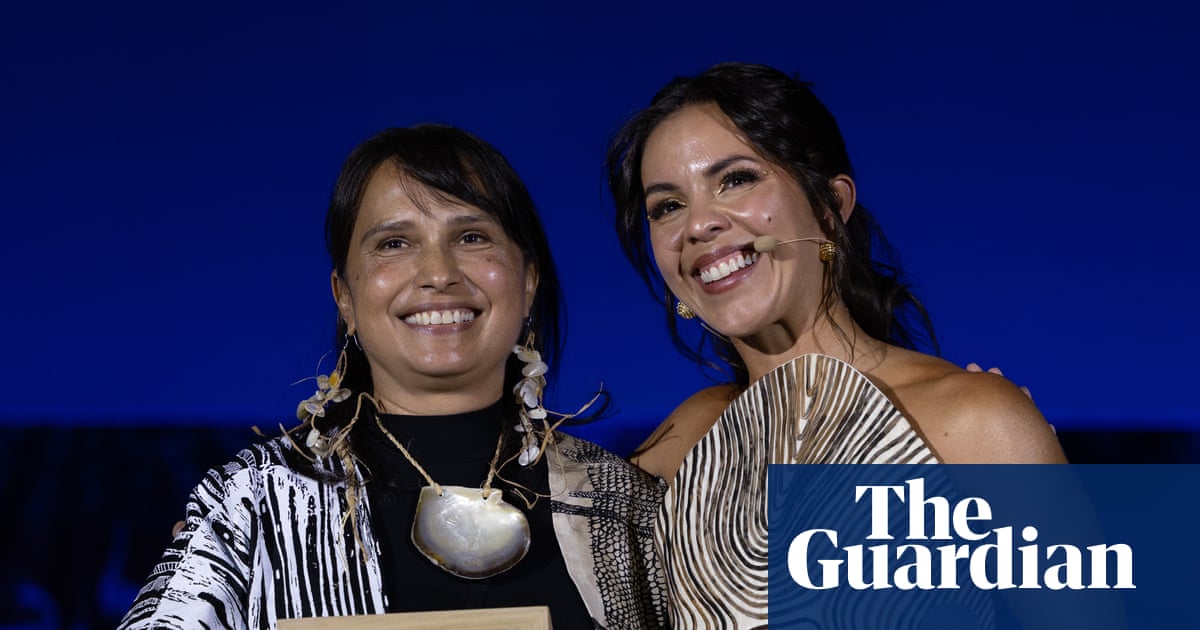
A Quandamooka artist whose work is made with locally harvested materials, Delvene Cockatoo-Collins, has been awarded fashion designer of the year at the seventh annual National Indigenous Fashion awards (Nifas).
Cockatoo-Collins reflected on the core of her practice: “Take only what you need.”
Speaking at the Wednesday evening ceremony, she said she is guided by a story passed down through the Nunukul, Ngugi and Goenpul peoples of Minjerribah (North Stradbroke Island), published by her grandmother in 1974.
In the story, two people gather too much native honey, without thought for their community. After falling asleep on the beach, the high tide sweeps them into the ocean, transforming them into dugongs.
“That story … is just as powerful now, especially in this time of overconsumption and fast fashion,” Cockatoo-Collins said during her acceptance speech. “We are the answer to that.”
‘What I’m doing at home on Country, I couldn’t do anywhere else’
Working from her studio on Minjerribah, Cockatoo-Collins files down shells into pearlescent adornments, hand dyes and screen prints fabrics.
Some of her work “exaggerates” fine mat-weaving techniques learned from her mother, highlighting their significance. Her three sons gather and process local plant fibres, such as tulipwood and cotton tree, keeping batch sizes.
“I know that what I’m doing at home on Country, I couldn’t do anywhere else,” Cockatoo-Collins told Guardian Australia before the ceremony began at Darwin’s Deckchair Cinema.
Looking across the Nifa’s gathering crowd, her eyes light up as recognises an attendee wearing one of her black and white jumpsuits.
“She bought that in 2024 … it’s based on my grandmother’s basket that’s about 120 years old,” Cockatoo-Collins said. “I look at each piece and I know that I’m still part of that.”
“An artist I adore, Judy Watson, talked about how the DNA of our old people is in those old objects in museums … It’s the same as what we are making today.”
Cockatoo-Collins was one of seven makers recognised across categories spanning fashion, traditional adornment, textile design and business.
Throughout the night, garments served as living archives of kinship and memory.
Wiradjuri, Yorta Yorta and Gangalu designer Lillardia Briggs-Houston won the textile design award, with an entry featuring hand-turned silk, bush-dyed using river red gum, collected from her daughter’s birthing tree.
Achieving the texture of tree bark required 12 separate dye batches. Briggs-Houston said the embellished cording evokes the memory of walking on Country with her grandfather and watching his hand trace a tree trunk.
“There’s a huge legacy behind First Nations fashion that hasn’t been highlighted for a long time,” Briggs-Houston said in her acceptance speech. She traced her textile roots to her grandmother, who sewed during the “servitude era” before becoming a teacher in the 1960s. “Fashion and textiles can be used as a catalyst for change. Being able to create these garments reflects the storytelling embedded in us and that legacy that connects with Country.”
‘The idea is to create something beautiful’
Yuwaalaraay designer Lucy Simpson won the wearable art award with a glass river-mussel shell necklace. It was made in response to grief she felt walking the dry bed of the Murray-Darling River during severe drought in 2009.
“I felt it deeply, it was a great sense of loss,” Simpson said in a pre-recorded video at the ceremony. “To see the deepest part of the river completely dry and over 2 million of our freshwater river mussels … perished in that period.
“As a freshwater woman, I have no right to say I belong to a place unless I’m giving back. The idea is to create something beautiful that can gently tell a story we have a responsibility to tell.”
2026 National Indigenous fashion award winners
-
Fashion designer award: Delvene Cockatoo-Collins – Goompi/Dunwich, Quandamooka Country, QLD
-
Textile design award: Lillardia Briggs-Houston – North Albury NSW
-
Business achievement award: KAFTA (Kimberley Aboriginal Fashion Textiles Art) – Rubibi/Broome, Yawuru Country, WA
-
Traditional adornment award: Michelle Pulatuwayu Woody Minnapinni – Wulirankuwu, Milikapiti, Tiwi Islands, NT
-
Wearable art award: Lucy Simpson – Gadigal/Wangal Country, Tempe, NSW
-
Cecilia Cubillo young achiever award: Jake Powers – Walmanyjun/Cable Beach, Broome, Yawuru Country, WA
-
Community collaboration: Bábbarra Women’s Centre x Tharangini Studio – Maningrida, Kunibidji Country, NT
Guardian Australia travelled to Darwin courtesy of Tourism NT
