


Six years after the COVID-19 pandemic accelerated the shift to remote work, hybrid and remote arrangements have become an established part of the labour market. About one in five Canadians now works remotely some or all of the time.
For many employees, this shift has brought greater autonomy and flexibility. Time previously spent commuting can instead be spent with family or friends. Research has also found that hybrid work can improve employee retention without sacrificing performance.
These benefits, however, may not be experienced equally. Remote and hybrid work may be particularly difficult for employees who are at the beginning of their careers, when much of their professional development still depends on learning from experienced colleagues.
Our new report, “The End of the Water Cooler: The Hidden Cost of Remote and Hybrid Work on Entry-Level Employees,” examines this problem.
Much of how we learn is informal
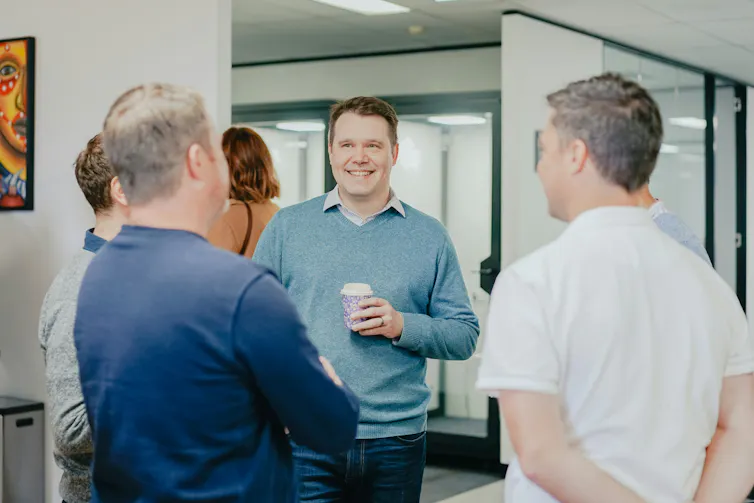
Think about your first professional job. Much of what you learned probably didn’t come from an employee handbook. You likely learned by observing those around you.
You heard how they approached a problem. Someone pointed out a mistake before it became a larger one. A mentor invited you to a meeting. You asked questions over coffee. You learned who fixed what, who to trust and how things really got done.
These are forms of tacit learning: knowledge that is difficult to codify and is often acquired through observation, experience and social interaction.
(Unsplash)
The workplace has traditionally provided an environment where this learning occurs alongside formal training. Over time, these interactions help employees develop judgment, confidence, professional networks and an understanding of how their organizations operate.
A study of software engineers illustrates the importance of proximity. Employees who sat near their teammates received 18.3 per cent more feedback on their code and produced higher-quality code. The gains were concentrated among younger and less tenured employees, who were still building human capital.
There is also evidence that remote work is affecting who gets hired. Employers are hiring fewer young workers for jobs that are easiest to do remotely. An emerging global study found that by 2025, early-career workers made up a substantially smaller share of new hires in highly remote-capable occupations. When researchers tested AI as an explanation, its effect largely disappeared. The remote-work effect remained.
Canadian hiring data shows similar trends, as entry-level professional jobs remain more likely to be on-site, while flexibility grows with seniority.
Those who need mentoring most
Younger workers also appear to place considerable value on opportunities for development and mentorship. Only 23 per cent of remote-capable Gen Z employees in the United States say they would prefer to work fully remotely, compared with 35 per cent of older generations.
A 2025 Deloitte survey found half of Gen Z respondents said they wanted a manager who would mentor them, while only 36 per cent said they were receiving that mentorship.
This creates a potential mismatch between where flexibility is available and where opportunities for learning may be most needed.
But experience must be acquired somewhere. If employers primarily hire workers who already have the skills they need, rather than developing those skills internally, fewer young workers get the opportunity to build experience in the first place.
Read more:
A robot stole my internship: How Gen Z’s entry into the workplace is being affected by AI
A problem that is easy to miss
The effects of reduced informal learning can be difficult for organizations to detect.
Employers can readily track completed projects, meetings and other outputs, but they are less likely to measure whether a junior employee has developed professional judgment, built relationships across an organization or learned how to navigate problems independently.

(Unsplash+)
Research suggests that remote work can change those relationships. A study of more than 61,000 Microsoft employees found that company-wide collaboration became more siloed when employees worked remotely, with employees communicating more within existing networks and less across organizational boundaries.
This is particularly relevant to early-career workers, who have not yet built extensive professional networks. Professional development depends partly on access to people who can provide information, feedback and opportunities.
Design hybrid work around learning
A return to five days in the office is not necessarily the solution. Research suggests that well-designed hybrid work can preserve flexibility without sacrificing performance or advancement.
The question is not whether employees should work remotely, but how organizations should structure remote and in-person work so employees can still develop their skills.
Employers need to design hybrid work around skill development, not attendance. Some forms of learning that once occurred informally may now need to be supported more deliberately. That means identifying which activities benefit from in-person interaction and making sure early-career employees have access to them.
This also puts responsibility on more experienced workers and managers. Mentoring, feedback and exposure to how work is actually done are essential to developing professional judgment and learning organizational norms.
Post-secondary institutions face a similar challenge with work-integrated learning. The value of a placement depends not simply on whether students gain workplace experience, but on the quality of supervision and their access to experienced professionals.
Governments that fund work-integrated learning programs should therefore place greater emphasis on developmental outcomes new graduates transition to the workforce.
Hybrid work has given many experienced workers more control over their time. But preserving this flexibility cannot come at the cost of compromising the development pathways of the next generation. Whatever our role or level of experience, we all have a part to play in making sure those opportunities continue.
